
LMI Octane Pipeline C4D
Cinema4D tools to Streamline your day to day assembly tasks in Octane Standalone.




Description
The only core tools you need to enable efficient assembly workflow with Octane Standalone. These tools remove friction and enable efficiency. Operating in preferable and optimised formats.
For pipeline related questions and technical support, consider joining us on Discord.
GPU Rendering Superpowers
Assembly Pipeline. Seamlessly bridged to Cinema4D.

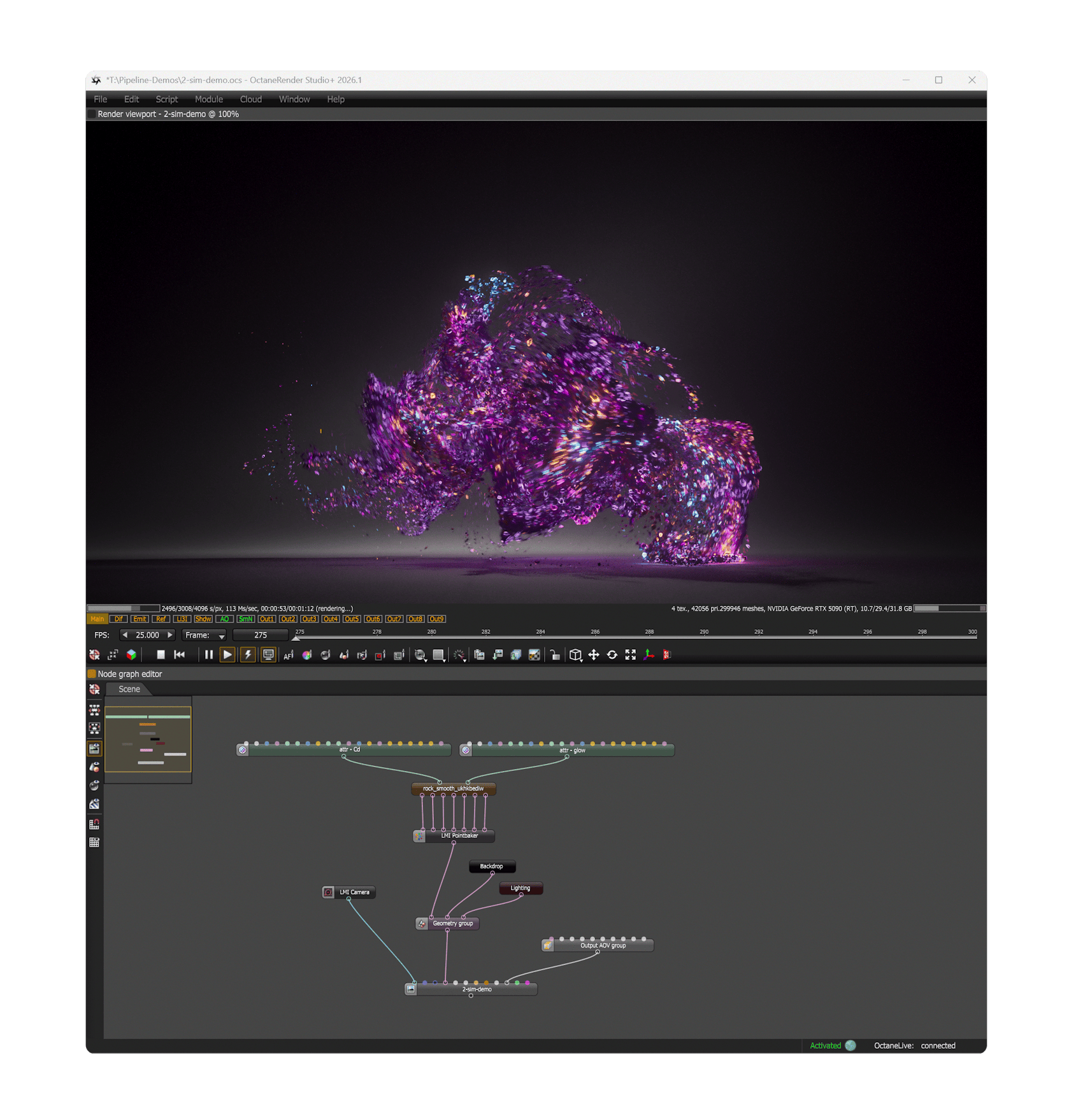
Pointbaker is purpose-built for our Octane Standalone–centric assembly pipeline. It takes incoming point data from Houdini, normalizes transforms into an Octane-friendly form, and exports a lightweight, drag-and-drop bundle ready for Standalone.
This is a major revision of the original baker. The exporter is now C++ accelerated, delivering a massive performance jump and making high-density, animated point workflows genuinely practical. Animation is first-class: Pointbaker preserves per-frame transforms cleanly and is designed so motion and motion blur evaluate efficiently at render time, keeping playback and iteration responsive.
Unlike previous iterations that produced multiple separate outputs, Pointbaker now exposes multiple variants as pins on a single node, so you can route and swap content cleanly inside Standalone without nodes overflow.
Under the hood it exports an OMPX bundle: high-throughput binary caches (.bin), optional attribute atlases (.exr), and a .lua manifest that builds a clean two-layer graph in Octane for a polished user experience.
This leap forward is made possible thanks to the OMPX Lua loader code developed by Padi Frigg, which we build on and super-charge until full binary instancing comes native into Standalone.
Please note: this is a workaround to get started with the pipeline, not a full production solution. Use it primarily as a scene driver, not for large, heavily scattered simulations.
Reasonably sized animated sims work well (the example shown on the screenshot is ~300k pebbles with a changing point count), but more ambitious setups can take exponentially longer to unpack and upload into GPU memory. We're waiting for Native USD scattering support.
This tool is best suited for driving birds, crowds, traffic, layout, and scattering. For static scatters, millions of instances are fine.
For FX work, exporting Alembic with a @width attribute works wonders.
Highlights:
• Octane Standalone-ready export via a single drag-and-drop .lua• C++ exporter for high-throughput baking (now dozens-of-times faster)
• Animation-friendly: robust transform capture, clean motion blur evaluation
• @variant pins, not variant files: multiple variants exposed as pins
• Auto-extracted Point attributes with exact naming
Previously, getting a camera into Octane Standalone was either painful or fragile: relying on Octane plugin for C4D, exporting ORBX, then doing a ridiculous number of steps just to extract and use the camera in Standalone. That’s not a pipeline - that’s friction.
Now LMI Camera is plugin-independent. It bakes an Octane camera directly into a single drag-and-drop file (think “Pointbaker, but for cameras”). Drop it into Standalone and you get a perfect mimic of your animated C4D camera: position, target/up vectors, lens parameters, focus, clipping - the full package.

Licensing
Tools are provided under a worldwide, non-exclusive license for use in any production context. You may install and use the toolset for any lawful purpose, including commercial work, client deliveries, internal studio pipelines, and distributed production environments.
All software is provided “as is”, without warranty of any kind, to the maximum extent permitted by applicable law.
Digital purchases are final and non-refundable, except where a refund is required by applicable consumer protection law.